
Faculty Mentoring Launch Committee
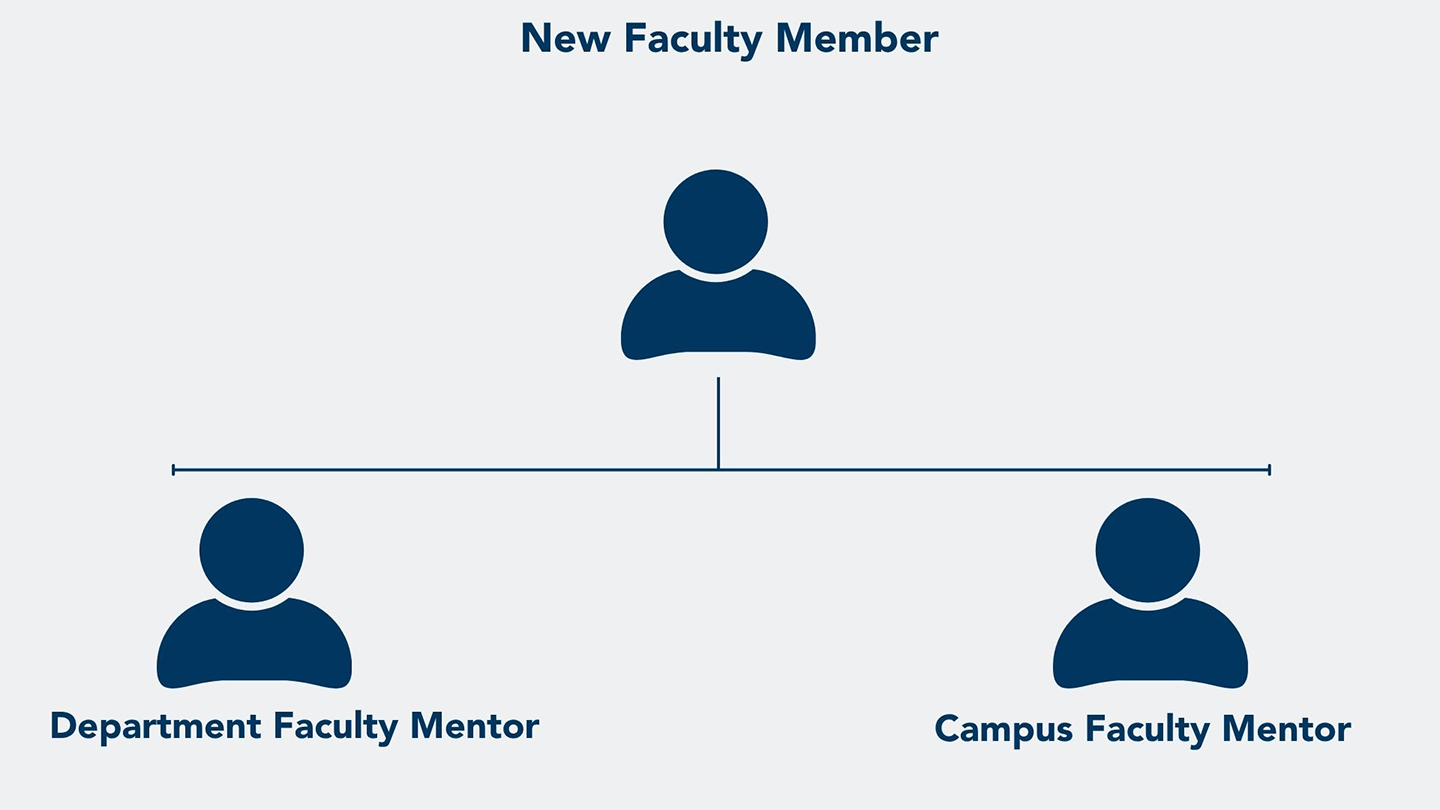
The Structure of the Launch Committee
A Launch1 committee consists of two mentors, as shown in the figure above.
- Department Faculty Mentor | a tenured faculty member in the new faculty member’s department who might share overlapping research interests. The Department Mentor is responsible for coordinating quarterly committee meetings and facilitating the meetings.
- Campus Faculty Mentor | a tenured faculty member outside the new faculty member’s department who might share overlapping research interests or lived experiences.
How Launch committees can support new faculty
Launch committees may help new faculty:
- Identify short-term and long-term professional goals
- Create plans and identify resources for meeting those goals
- Develop effective time management strategies
- Increase understanding of UCSB’s academic personnel procedures
- Develop clear expectations for tenure and promotion
- Connect with potential collaborators or mentors
- Improve ideas for research or creative activities
- Provide feedback on manuscripts, book chapters, or grant proposals
- Increase teaching and mentoring effectiveness
- Help navigate challenging relationships with colleagues or students
How Launch Committees are assigned:
Each year, the Program Director in consultation with the Vice Provost for Academic Affairs, works with each new faculty member, their home department, and their Dean’s office to establish their Launch committee. In the summer prior to starting at UCSB, new faculty will receive an email inviting them to participate in the Faculty Mentoring Program. Once a Launch committee is identified, the new faculty member will be introduced to their committee members, and the Department Mentor will be responsible for scheduling their meetings. New faculty are strongly encouraged to participate in the Launch committee and the other mentoring program activities throughout the academic year.
1 Launch committees have also been utilized at other universities, such as University of Michigan, The Ohio State University, and UC Davis.
“By supporting the success and well-being of our faculty, we can build community, support the mission of the University, and advance our commitment to transformative teaching, innovative research, and impactful service.”
David Marshall
Executive Vice Chancellor and Provost
Mentor Orientation and Responsibilities
Mentor Training
Faculty Mentors are expected to attend an orientation at the beginning of the academic year, where they have a chance to meet their mentee and review a number of topics, such as program expectations for mentors.
Expectations for the Launch Committee
Suggestion: The Launch committee is expected to meet in person at least once per quarter, but it can meet more often if this would benefit the new faculty member. New faculty are strongly encouraged to meet with individual mentors when they would like additional support. Launch committees are encouraged, when possible and desired, to continue offering support to new faculty in subsequent years as they progress through their career.
Department Mentors’ Responsibilities
- Proactively contact the Launch committee at the beginning of every quarter to schedule meeting
- Identify a meeting space
- Send reminder emails to the Launch committee in advance of each meeting
- Work with the new faculty member to determine where to guide the discussion
- Follow up on any action items and summarize key points of the discussion for distribution to the committee after each meeting (e.g., meeting minutes)
- Ensure that the new faculty member has a voice that is heard and respected
- Ensure that the new faculty member feels they are benefiting from their participation on the Launch committee
- Communicate to the Program Director additional ways that the mentoring program can support new faculty
“The Faculty Mentoring Program is designed to provide a comprehensive support system, both formal and informal, to meet faculty’s varying needs as they navigate their new responsibilities and their professional goals.”
Dana Mastro
Vice Provost for Academic Affairs
Professional Development and Social Events
Professional Development
Every quarter faculty will be invited to participate in a variety of professional development workshops and social events.